
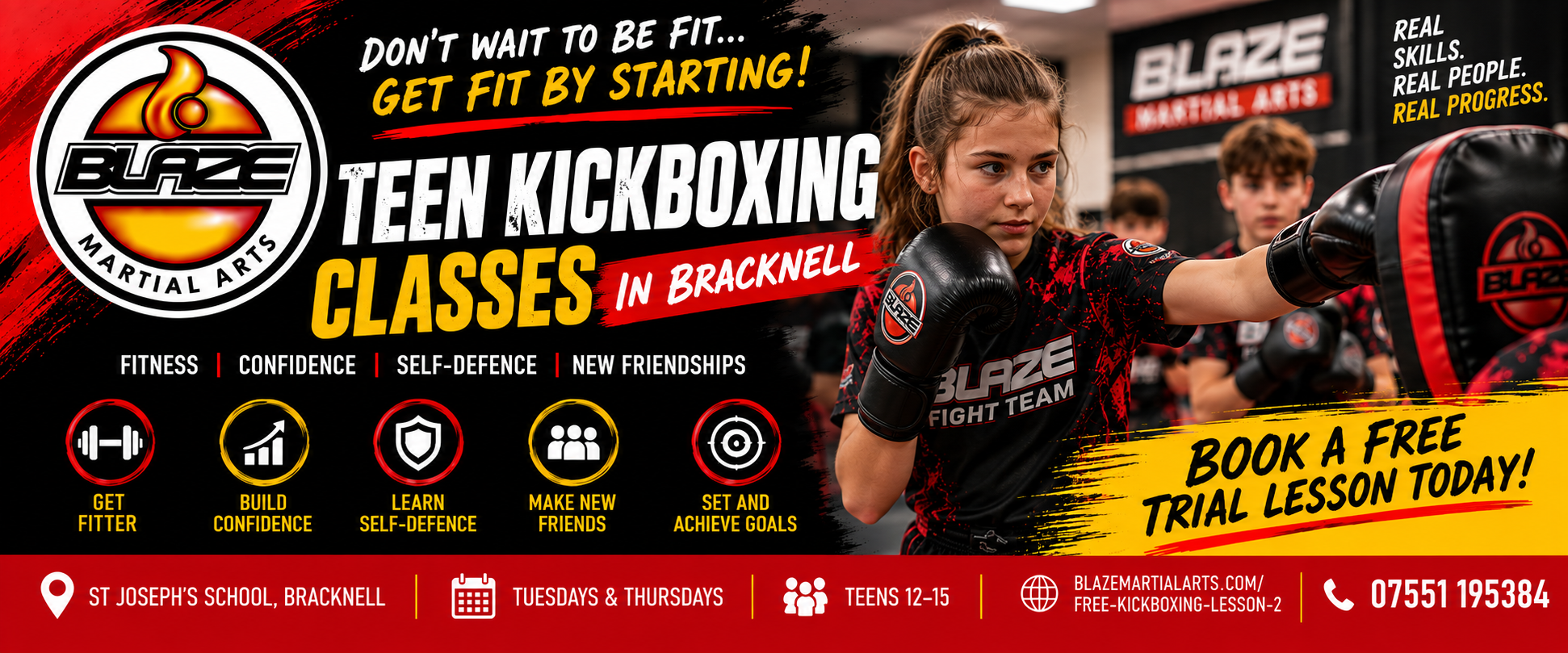
Teen kickboxing classes are often something teenagers put off because they think they need to be fitter, stronger or more confident before they walk through the door. I think that has it completely backwards.
You do not get fit so that you can start kickboxing. You start kickboxing, then your fitness improves through training.
The same applies to confidence. Very few beginners arrive feeling completely comfortable on day one because they are walking into a new room, meeting new people and trying something unfamiliar.
Feeling a little nervous is normal. At Blaze Martial Arts, the job of the instructor is not to judge where a beginner starts, but to help them move forward from there.
You can find out more about Blaze Martial Arts and the classes we run across Bracknell, Windsor, Ascot and Wokingham.
Teen Kickboxing Classes: Do You Need to Be Fit First?

No, a teenager does not need to be fit before starting kickboxing. A sensible beginner class should be designed for beginners.
That sounds obvious, but I regularly hear variations of the same concerns: “I need to get fitter first.” “I’m not flexible enough.” “I’ve never done anything like this.” “I’ll look silly.” “I don’t know anyone.”
None of those are reasons to wait. Fitness is developed gradually, technique is taught and coordination improves through repetition.
The first lesson is not an audition.
After more than 40 years in martial arts, I have seen plenty of naturally athletic beginners struggle with technique. I have also seen completely untrained beginners surprise themselves very quickly.
Being willing to learn matters far more than arriving in shape.
Why Teenagers Often Put Off Starting
Teenagers can be extremely self-conscious. They notice who looks confident, who seems sporty and who appears to know what they are doing.
Walking into a new activity can therefore feel like a bigger step than adults sometimes realise. That is one reason I think martial arts can work so well when it is taught properly.
Everybody starts somewhere. Nobody walks into their first kickboxing class with perfect footwork, sharp combinations and great timing.
Beginners see other people learning too. They make mistakes, try again and begin to understand that getting something wrong is not embarrassing.
It is part of improving. That is useful on the mats, but it is also a useful lesson for life.
Fitness Comes From Training, Not Before It
Kickboxing gives teenagers a reason to move because they are learning a skill at the same time. Pads need to be hit, footwork needs to be practised and combinations have to be remembered.
Rounds gradually become more comfortable. The NHS exercise guidance is a useful resource for parents who want to understand the importance of regular physical activity for children, teenagers and adults.
That does not mean every session has to leave a teenager exhausted. Good training should be progressive and appropriate to the person in front of you.
One week they might manage a round more comfortably. A month later their balance is better, then their technique becomes sharper and they recover more quickly between exercises.
Progress happens because they trained. It does not happen because they waited until they were “ready”.
Confidence Should Be Earned, Not Pretended
I am not a fan of telling young people to “just be confident”. Confidence usually needs evidence.
A teenager learns a combination they could not do three weeks ago. They complete a grading, partner with somebody new or speak to an instructor without their parent doing it for them.
They get through a tough round and realise they had more in them than they thought. Those experiences build something real.
Positive experiences with sport and physical activity are important, particularly while young people are deciding what sorts of activities they actually enjoy. Sport England’s Active Lives research is a useful source for parents interested in children’s and young people’s activity levels.
The atmosphere of a class matters just as much as the exercises. Teenagers need to be challenged, but they also need to feel that they belong there.
What a Blaze Teen Beginner Class Actually Looks Like
At our Bracknell school at St Joseph’s School, classes run on Tuesdays and Thursdays. Having that regular routine gives students a clear place and time to train each week.
A typical beginner session may include a warm-up, basic footwork, punching and kicking combinations, pad work, fitness and practical self-defence skills. The aim is to teach rather than simply throw exercises at people and hope they work it out.
Nobody expects a first-timer to know the terminology. Nobody expects perfect technique or expects them to keep up with somebody who has already trained for years.
They are expected to listen, have a go and gradually improve. That is enough.
“But My Teenager Isn’t Sporty”
That is probably one of the best reasons to try a different type of activity. Not every teenager enjoys football, rugby, running or going to a conventional gym.
Some simply have not found the activity that clicks for them. Martial arts is different because improvement is very individual.
A student can work on their own technique while still training as part of a group. There is no need to be the fastest person in the room, score a goal or be selected for a team.
The target is progress. That can suit teenagers who have never really considered themselves “sporty”.
Safety and Good Coaching Matter
Parents should ask who is teaching their teenager, what experience those instructors have and how safeguarding is handled. Those questions matter far more to me than how flashy a school’s advertising looks.
Blaze Martial Arts has achieved the Safeguarding Code in Martial Arts, and safeguarding remains an important part of how our children’s and teenagers’ programmes are run.
Teenagers should be able to train in an environment where standards are clear, instructors behave professionally and beginners are treated properly. Good coaching should make somebody want to improve, not make them afraid of getting something wrong.
At Blaze, our instructors bring substantial martial arts experience to the mats. My own martial arts journey now spans more than 40 years, and one thing has never changed: beginners deserve good coaching from their very first lesson.
Do Teenagers Have to Compete?
No, competition is available for students who want it, but it is not compulsory. Some teenagers love the idea of testing themselves competitively while others have absolutely no interest in it.
Some want fitness, self-defence, confidence and a social activity. Those are equally valid reasons to train.
A good martial arts school should give students opportunities without trying to force everybody down exactly the same path. Martial arts should adapt to the student’s goals rather than expecting every student to have identical ambitions.
Teen Kickboxing Classes Are for Beginners Too
The biggest mistake is waiting for the perfect moment. “I’ll start when I’m fitter”, “I’ll start when school calms down” and “I’ll start when I feel more confident” can very easily turn into never starting at all.
Confidence, fitness and skill are often the result of beginning. They are not requirements for walking through the door.
If your teenager is curious about kickboxing, let them experience a proper beginner class and decide from there. There is far less pressure in trying one lesson than imagining for months what the first lesson might be like.
Our teen kickboxing classes in Bracknell are designed to help beginners learn at a sensible pace, develop fitness and build genuine skill without needing previous experience.
You can book a free Blaze Martial Arts trial lesson or call 07551 195384. We would love to welcome them onto the mats and show them what a real beginner class feels like.