
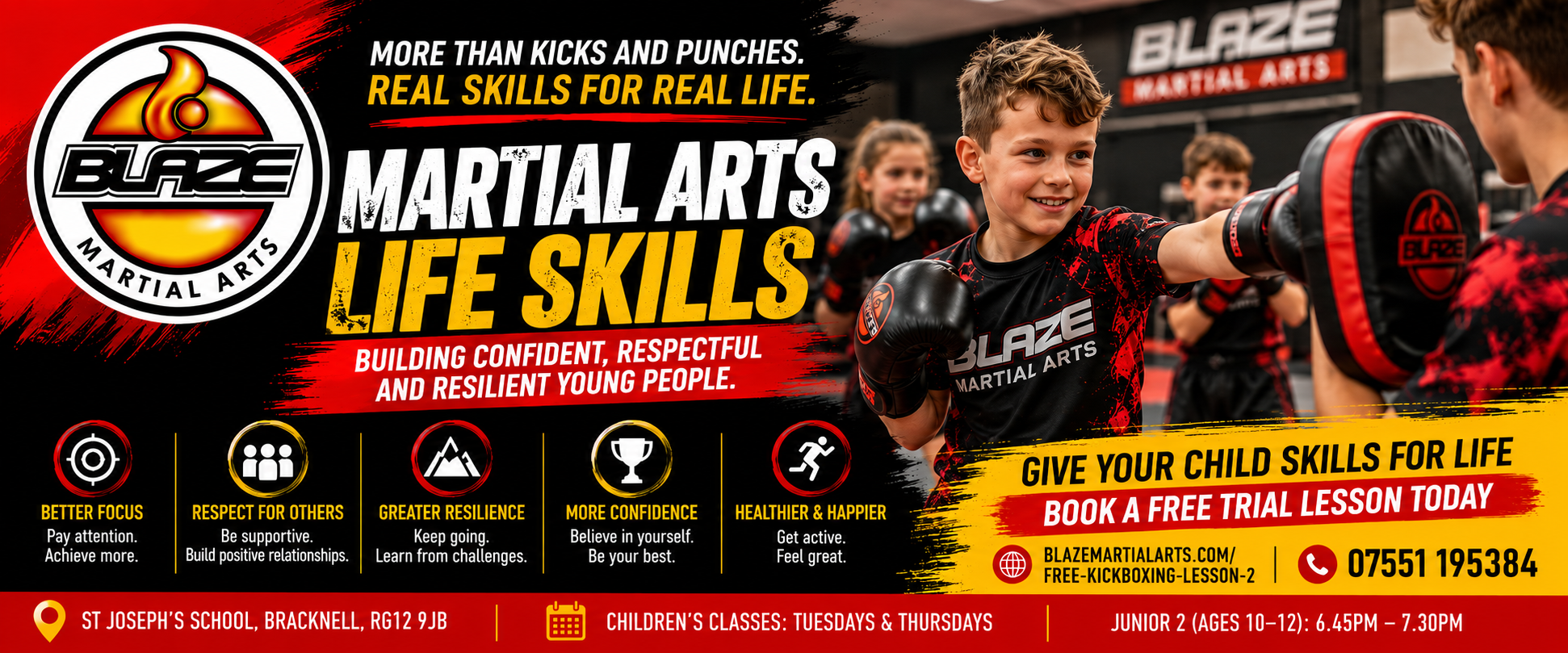
Martial arts life skills are one of the biggest reasons I still believe so strongly in teaching children after more than 40 years on the mats.
Parents often arrive at Blaze because their child wants to learn kickboxing.
That is absolutely fine.
Learning how to punch, kick, move, defend yourself and become fitter is part of what we do.
But the techniques are only half the story.
The things that interest me just as much are what happens when a child struggles with something, how they respond when they make a mistake, whether they can listen properly, work with somebody else and keep going when a technique does not come easily.
Those are skills that travel home with them.
They go into school.
They go into friendships.
They stay useful long after the training session has finished.
You can learn more about Blaze Martial Arts and our approach to training.
What Are Martial Arts Life Skills?
Martial arts life skills are the behaviours children develop through regular structured training, including focus, respect, self-control, perseverance, confidence and the ability to work with other people.
None of those skills are created by making a child stand still while an instructor gives them a ten-minute speech about discipline.
Children learn them by doing.
A student has to listen because they need to understand the next combination.
They have to concentrate because somebody is holding pads for them.
They have to control their technique because their training partner is not a punchbag.
They have to keep trying because they will not get everything right on the first attempt.
That is what makes martial arts different from simply talking to children about good behaviour.
The lesson becomes practical.
Focus Is Something Children Can Practise
Parents regularly tell me that they want their child to improve their concentration.
That can be difficult because you cannot simply tell somebody to concentrate harder and expect an instant change.
Concentration needs practice.
In a martial arts class, children constantly have small reasons to focus.
Watch the demonstration.
Remember the combination.
Listen for the command.
Keep your hands up.
Move your feet.
Work with your partner.
Then the instructor changes something and they need to adapt.
That is a lot happening in one session, but because the children are physically involved, it often feels very different from sitting at a desk being told to pay attention.
The NHS recommends that children and young people aged 5 to 18 average at least 60 minutes of moderate or vigorous physical activity each day across the week, alongside a variety of activities that develop movement skills, muscles and bones. nhs.uk
You can read the full NHS physical activity guidance for children and young people.
Respect Should Work Both Ways
Respect is another word used constantly in martial arts.
Sometimes it is misunderstood.
To me, respect does not mean children should be frightened of their instructor.
It means learning how to behave properly around other people.
Listen when somebody is talking.
Treat your training partner well.
Do not laugh when somebody gets something wrong.
Help somebody who is struggling.
Accept correction without taking it personally.
That final one is particularly useful.
Children are going to be corrected throughout their lives.
At school.
At work.
In sport.
Learning that correction is not the same as criticism is a valuable skill.
A good instructor should also show respect to the children.
You can have high standards without humiliating somebody.
I have always believed that children learn far more from instructors they trust than instructors they fear.
Martial Arts Life Skills Include Learning How to Struggle
This might sound strange, but I think children need opportunities to struggle.
Not to fail constantly.
Not to be overwhelmed.
They need manageable challenges.
There is a difference.
Imagine a child trying a new kick.
It feels awkward.
Their balance is wrong.
They put their foot down.
They try again.
Still wrong.
An instructor gives them one small correction.
They try again.
Better.
Another attempt.
Suddenly it works.
That child has just learned something far more useful than one kick.
They have learned that being bad at something initially is not a reason to stop.
That lesson matters.
Life does not reward us with instant success every time we try something new.
Fitness Without It Feeling Like Exercise for Exercise’s Sake
Children also need to move.
Sport England’s Active Lives framework measures children as active when they average at least 60 minutes of moderate-intensity physical activity a day, in line with the Chief Medical Officer’s guidance. Sport England
You can see more information through Sport England’s Active Lives research.
Martial arts gives children a reason to move.
They are not just running because somebody told them to run.
They are moving towards a target.
Practising a kick.
Holding pads.
Working through a combination.
Learning balance.
Reacting to somebody else.
For many children, having a skill attached to the exercise makes activity far more interesting.
Confidence Comes From Evidence
Confidence is one of the biggest reasons parents bring children to Blaze.
I understand why.
But confidence should not be built on empty praise.
Children are smart.
If you tell them they are brilliant at something when they know they are not, they can see straight through it.
Real confidence comes from evidence.
“I couldn’t do that before.”
“Now I can.”
“I was nervous about grading.”
“I did it.”
“I didn’t know anyone when I joined.”
“Now I have training partners.”
Those little pieces of evidence accumulate.
That is much stronger than repeatedly telling a child to believe in themselves without giving them anything to base that belief on.
What This Looks Like in a Real Blaze Class
At our Bracknell school at St Joseph’s School, we run age-specific children’s classes on Tuesdays and Thursdays.
Our Junior 2 group for 10 to 12-year-olds trains from 6.45 pm to 7.30 pm.
That age group is a particularly good example of why structure matters.
By 10, 11 and 12, children are becoming more aware of what other people think.
They compare themselves more.
School becomes more demanding.
Friendships can become more complicated.
In class, they have something very clear to work on.
Listen.
Train.
Improve.
Help your partner.
Try again.
Some evenings they walk off the mats absolutely buzzing because something clicked.
Other evenings they have had to work for every bit of progress.
Both types of lesson are useful.
Children Should Feel Safe While They Learn
Nothing matters more than creating an environment where children can train safely.
Blaze Martial Arts has achieved the Safeguarding Code in Martial Arts, which recognises organisations working to appropriate safeguarding standards.
Parents can find information about the scheme at the Safeguarding Code in Martial Arts.
That is something I believe parents should look at when choosing any martial arts school.
Who is teaching?
How experienced are they?
How are children spoken to?
Is safeguarding taken seriously?
Does the class have structure?
A flashy video tells you very little about those things.
Watching a real class tells you far more.
Goal Setting Without Turning Everything Into Pressure
Belts, gradings and new techniques give children something tangible to work towards.
That does not mean everything has to become a competition.
Some children love competition.
Others have no interest in it.
Both can benefit from martial arts.
The important part is learning how to work towards something.
Set a target.
Practise.
Receive feedback.
Improve.
Reach it.
Then start on the next one.
That cycle is useful whether somebody eventually becomes a black belt or simply trains for a few years and takes those habits into something else.
Martial Arts Life Skills Stay Useful Long After Class
The best children’s martial arts classes should produce more than children who can kick well.
They should help develop young people who can listen, focus, show respect, work with others, cope with mistakes and keep trying.
That is what martial arts life skills mean to me.
The kicking and punching matter.
The person learning them matters more.
If you would like your child to experience a Blaze class for themselves, you can book a free Blaze Martial Arts trial lesson.
Free trial: https://blazemartialarts.com/free-kickboxing-lesson-2/
Call us: 07551 195384
We would love to welcome you onto the mats.