
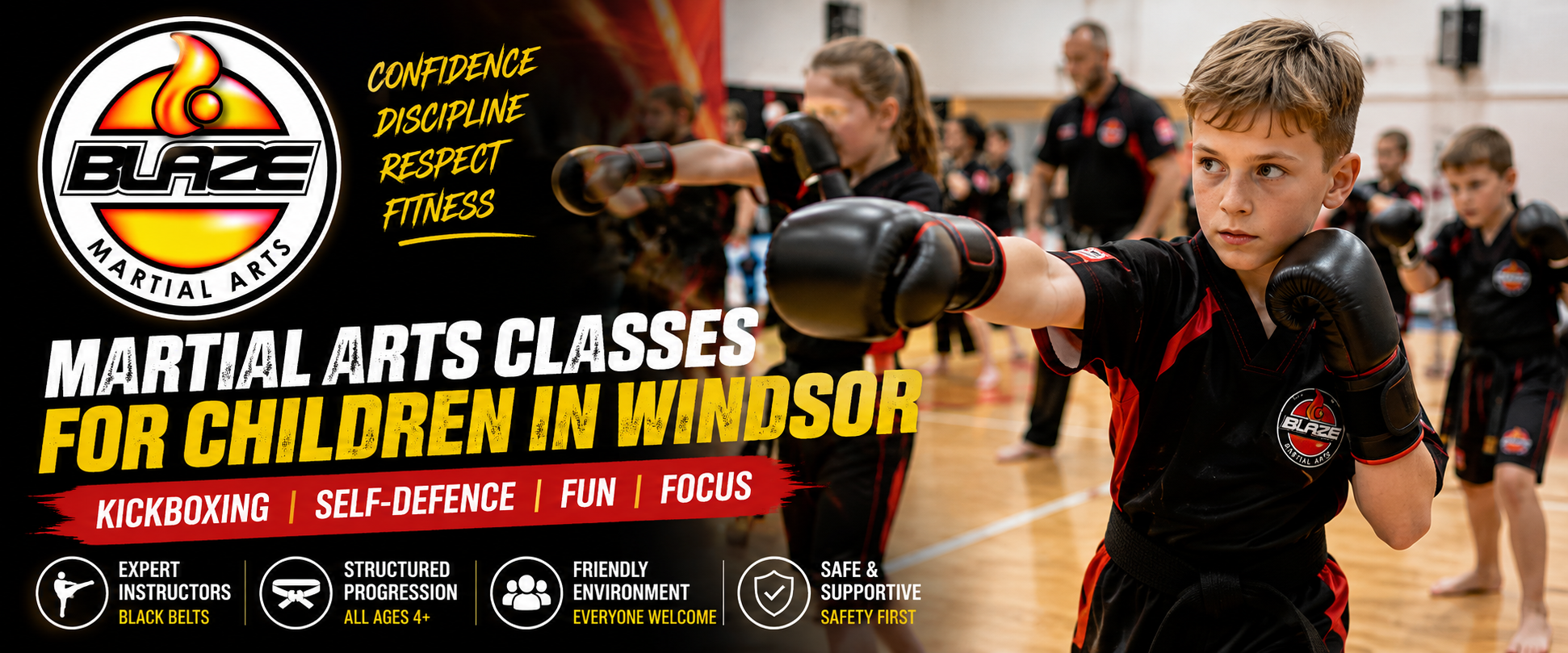
Martial arts classes for children in Windsor should combine exercise, discipline, fun and proper hands-on teaching. At Blaze Martial Arts, children learn kickboxing and practical martial arts skills while experienced black-belt instructors continually watch, correct and encourage them.
Beginners aren’t expected to know anything before they walk through the door.
That last point is important.
Parents sometimes imagine their child arriving at their first martial arts lesson and being surrounded by children who already know exactly what they’re doing.
They worry their son or daughter will stand at the back looking completely lost.
Trust me, we know what beginners look like.
They’re supposed to be beginners.
On a Tuesday or Thursday evening at Hilltop School in Windsor, you’ll hear the thud of kicks landing on pads, instructors calling combinations and the occasional squeak of trainers on the hall floor.
At 6.45 pm, our Junior 2 class starts for children aged 10 to 12.
Some arrive bursting with confidence.
Others barely want to make eye contact with us on their first evening.
Both are welcome.
The important question is what happens next.
What Makes Our Martial Arts Classes for Children in Windsor Different?
Our instructors don’t simply demonstrate a technique and then stand at the front watching the whole room. We move around the class, watch individual students and correct what they’re actually doing.
That sounds obvious.
I don’t think it always is.
If we’re teaching a kick, we’ll demonstrate it first. The children then practise and the instructors start moving around the room.
Maybe one child isn’t turning their supporting foot.
Another has their hands down.
Someone else has understood the movement perfectly and is ready for the next detail.
That’s where teaching really happens.
A child can be standing in a martial arts class without actually being taught.
I feel strongly about that.
At Blaze Martial Arts, our instructors are expected to engage with the students. If somebody is struggling, help them. If something needs correcting, correct it. If a child has done something particularly well, tell them.
Children shouldn’t become invisible simply because there are other people in the room.
We currently have approximately 370+ active students across Blaze Martial Arts, but every one of them started as a beginner.
Our job is to teach the person in front of us.
Does Every Child Have to Learn at the Same Speed?
No. Children develop physically and emotionally at different rates, so good martial arts teaching has to recognise that. The goal is steady improvement rather than expecting every child to perform identically.
This becomes particularly noticeable between the ages of 10 and 12.
You can have two 11-year-olds standing next to each other who are completely different.
One might be tall, athletic and confident.
The other may be quiet, uncoordinated and nervous about getting something wrong.
Put them through exactly the same lesson with no individual attention and one of them is probably going to have a much better experience.
That’s why our instructors circulate.
Blaze’s main classes are taught by black-belt instructors with at least 15 years of martial arts experience.
I’m Chief Instructor Justyn Billingham, a 7th Dan with around 40 years in martial arts. Ollie is a 4th Dan and Cyrus, who leads much of our Bracknell teaching, is a 2nd Dan.
I’m not telling you this to impress you.
Experience helps an instructor recognise when to push a student and when somebody needs a little more help.
There’s a big difference.
Good martial arts instruction adapts to the student without lowering the standards they’re working towards.
Is Kickboxing Suitable for a Shy Child?
Yes. A shy child can learn kickboxing without being forced to suddenly become loud or outgoing. Confidence is normally built through repeated experiences of doing something successfully, being recognised for it and gradually accepting new challenges.
I’ve seen this happen many times.
A child may initially avoid putting their hand up.
A few months later, they answer a question.
Eventually, they might demonstrate a technique.
Those steps can look tiny to somebody watching from outside.
To the child, they can be enormous.
This is one reason I don’t believe martial arts should be taught as one big shouting exercise.
Discipline matters.
Standards matter.
Respect matters.
But shouting at a nervous 10-year-old isn’t my idea of character development.
We want children to become comfortable enough to try.
Sometimes they’ll get it wrong.
Good.
That means we’ve got something to teach them.
Confidence grows when children discover that making a mistake isn’t a disaster.
What Do Children Actually Learn at Blaze Martial Arts?
Kickboxing is our main martial art, but the Blaze programme also incorporates practical self-defence and other skills. Students develop punching, kicking, movement, pad work and defensive techniques within a structured grading system.
We also introduce elements of ground fighting and practical self-defence, drawing on the wider experience within Blaze, including Keysi Fighting Method and Defence Lab.
Competition is available too.
The Blaze fight team, led by Ollie, regularly attends tournaments and our competitors frequently return with trophies and medals.
But competition isn’t compulsory.
Some children love it.
Others have absolutely no interest in standing in front of judges on a Sunday morning, thank you very much.
Both can become excellent martial artists.
For me, the grading system is particularly valuable because it gives children something concrete to work towards.
A new belt isn’t handed out simply because a certain amount of time has passed.
They have to learn.
They have to practise.
Eventually, they have to demonstrate what they can do.
That teaches persistence in a very practical way.
How Important Is Safeguarding When Choosing a Martial Arts School?
Safeguarding should be one of the things a parent checks before choosing any martial arts school. Good coaching matters, but parents should also know that the club has proper policies, procedures and standards in place.
Blaze Martial Arts has achieved the Safeguarding Code in Martial Arts, which recognises martial arts organisations that meet safeguarding standards.
Parents can also read Sport England’s safeguarding guidance for martial arts for further information about what good safeguarding should look like when choosing a martial arts provider.
For me, this matters because instructors can work with children for years.
Sometimes from the age of four right through into their teens and adulthood.
Parents are trusting us with far more than kicking and punching.
That trust matters.
Can You Really See a Difference in Children Over Time?
Yes, but genuine improvement usually happens gradually. One of the clearest examples at Blaze is Seth, who joined our Junior 2 programme at 11 years old.
When Seth started, he was extremely quiet.
He kept his head down.
He didn’t want to answer questions, demonstrate techniques or take a grading.
There was no dramatic breakthrough after three lessons.
He simply kept coming.
We kept coaching him.
Over roughly nine to twelve months, things changed.
Seth became chatty.
He started engaging properly with drills.
He became willing to demonstrate techniques in front of other students.
Then, in June, he completed his first grading.
For somebody else, taking a grading might seem completely normal.
For Seth, it represented a significant step because several months earlier he wouldn’t even consider doing it.
One thing I’ve learnt over the years is that you can’t rush that sort of confidence.
You create the environment.
You teach.
You encourage.
You maintain standards.
Then you give the child time to grow into them.
Something to think about…
Frequently Asked Questions
What age can my child start martial arts in Windsor?
Blaze Martial Arts accepts children from age four. At our Windsor school, Little Ninjas aged 4 to 6 train from 5.15 to 6.00 pm, ages 7 to 9 train from 6.00 to 6.45 pm, and children aged 10 to 12 train from 6.45 to 7.30 pm.
Does my child need to be fit before starting kickboxing?
No. Fitness develops through training, so we don’t expect a new student to arrive already fit. Children have different starting points and exercises can be approached according to their current ability. Consistent attendance is far more useful than waiting until a child somehow becomes fit enough to start.
What should my child wear to their first kickboxing class?
For a first trial lesson, comfortable sports clothing is normally the sensible choice. There’s no need to buy martial arts equipment before your child has even tried a class. The important thing is that they can move comfortably and enjoy finding out what the lesson is actually like.
Are Blaze Martial Arts instructors experienced?
Yes. Blaze main classes are taught by black-belt instructors with at least 15 years of martial arts experience. Chief Instructor Justyn Billingham is a 7th Dan with approximately 40 years of martial arts experience, and the teaching team includes experienced senior black belts across the schools.
Looking for Martial Arts Classes for Children in Windsor?
If you’re considering martial arts classes for children in Windsor, my advice is simple.
Come and watch us teach.
Don’t choose a martial arts school solely because the website looks good or somebody has promised you that your child will become super-confident in six weeks.
See how the instructors interact with the children.
See whether they walk around.
See whether they correct people.
See whether the children look as though they’re learning and enjoying themselves.
Our Windsor classes run every Tuesday and Thursday at Hilltop School, Clewer Hill Road, with separate classes for ages 4 to 6, 7 to 9 and 10 to 12, followed by our teenager and adult programmes.
If you live in Windsor or the surrounding area, you’re very welcome to bring your child along and try Blaze Martial Arts for yourself.
You can book a free trial lesson here.
Alternatively, call 07551 195384.