
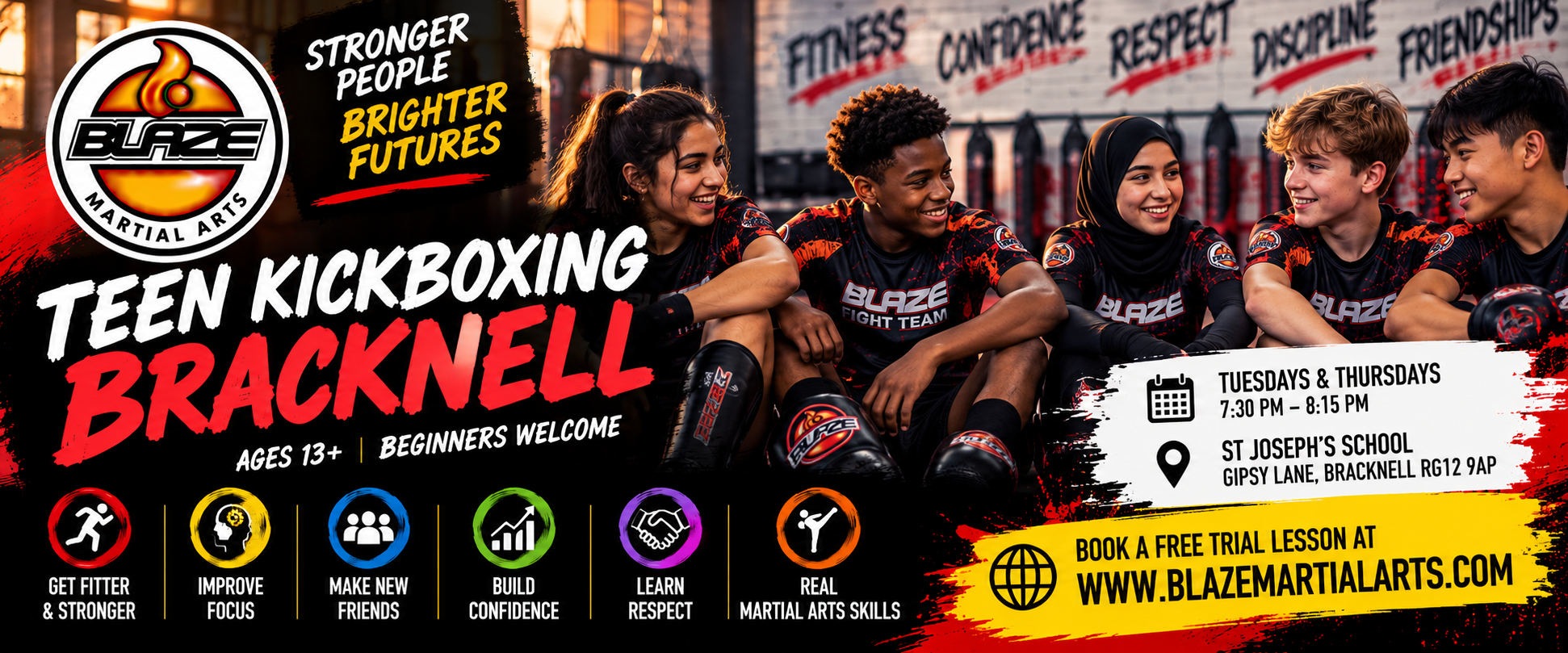
Teen kickboxing Bracknell offers something that can be surprisingly difficult to find for young people: a challenge that is physical, social and genuinely rewarding.
I hear plenty of adults complain that teenagers spend too much time on their phones. I understand the frustration, but I don’t think simply telling them to put the phone down is much of a solution. They need something worth putting it down for.
For some, that might be football, dance or the gym. For others, it could be martial arts.
At Blaze Martial Arts, we teach teenagers to kickbox properly, with structured lessons that develop technique, fitness, confidence and respect. They don’t need to be naturally sporty, and they certainly don’t need to arrive feeling confident.
Teen Kickboxing Bracknell Gives Young People a Real Challenge
There is a difference between being kept busy and learning something difficult.
A teenager can spend an hour exercising and feel tired afterwards. That has value. But if they also learn how to throw a better punch, move their feet correctly or put a combination together, they have something concrete to take away.
They can measure progress against their own previous performance, rather than comparing themselves with everyone else.
I have taught martial arts for more than 40 years, and I still believe this is one of the best things about it. You never run out of things to improve. Even experienced black belts go back to their basics.
That is a useful lesson at an age when it is easy to feel you should be good at everything immediately.
Confidence Is Earned, Not Handed Out
Confidence is not something an instructor can simply give a teenager with a motivational speech.
It comes from doing things that initially feel awkward, receiving feedback and realising they are getting better.
The first time a beginner tries a kickboxing combination, their feet may be in the wrong place. Their hands may drop. They may forget which punch comes next.
That’s normal.
A few sessions later, the same combination can start to feel natural. That small improvement matters because they know they have earned it.
For a quiet teenager, the first achievement might be walking into the room and joining in. For somebody who is already confident, it might be learning to slow down, listen and accept correction.
Different starting points. The same opportunity to grow.
Fitness Without Another Lecture About Fitness
Teenagers don’t need another adult telling them that exercise is important. They need an activity they enjoy enough to repeat.
Kickboxing keeps them moving through footwork, pad work, kicking, punching, balance and conditioning drills. It asks them to coordinate their body while concentrating on a task.
The NHS physical activity guidance for children and young people recommends an average of at least 60 minutes of moderate or vigorous activity a day across the week for ages 5 to 18. It also identifies martial arts as an activity that can help strengthen muscles and bones. nhs.uk
A Blaze lesson can contribute to that wider routine. It isn’t a substitute for every other kind of activity, and it doesn’t need to be.
Learning to Listen and Work With Others
Good kickboxing requires attention.
Students need to watch a demonstration, listen to instructions, remember a combination and work safely with a partner. If they’re holding focus pads, they also have a responsibility to the person training with them.
That is very different from passively watching a video.
The skills are practical: wait your turn, communicate clearly, show respect, accept feedback and try again.
I don’t claim that every teenager who trains will suddenly become perfectly organised at school or at home. But martial arts gives them regular opportunities to practise habits that matter beyond the training hall.
It’s Not About Turning Teenagers Into Fighters
This is a common misunderstanding.
Some people hear ‘kickboxing’ and picture aggressive sparring or a teenager being thrown in at the deep end. That’s not how a beginner should be introduced to martial arts.
At Blaze, the first lesson is non-contact. Beginners are shown the basics and work on pads and other training equipment. They can experience a proper class without being expected to fight anybody.
Some students eventually become interested in competition. Many never do. Both are welcome.
Learning a martial art can be about fitness, discipline, self-defence awareness and enjoying the challenge of getting better.
What Happens at Our Bracknell Teen Kickboxing Classes?
Our teenagers and adult beginners train together at St Joseph’s School, Gipsy Lane, Bracknell RG12 9AP, on Tuesdays and Thursdays from 7:30 pm to 8:15 pm.
The class is for teenagers aged 13 and over as well as adult beginners, rather than a separate teenagers-only group. That is worth knowing before you come down.
Sessions include a mixture of warm-up exercises, technique, footwork, pad work, combinations and conditioning. The emphasis is on learning the fundamentals properly and progressing at a sensible pace.
There is no expectation that somebody arriving for their first lesson will keep up with a student who has trained for years. Our instructors adjust the teaching to suit experience and ability.
The aim is to give beginners a positive first experience of real kickboxing.
The Right Environment Matters More Than a Flashy Advert
Parents should look beyond the posters and ask who is actually teaching their child.
How experienced are the instructors? Is the class structured? Are beginners supported? Are safeguarding standards taken seriously?
Blaze Martial Arts has achieved the Safeguarding Code in Martial Arts, which recognises providers that have demonstrated appropriate safeguarding practices. That matters when families are deciding where to place their trust.
I also agree with Sport England’s approach to positive experiences for young people: activities should be enjoyable, supportive and confidence-building if we want young people to stay active. Safeguarding Code
An instructor can challenge a teenager without humiliating them. In fact, that’s how good coaching should work.
What if My Teenager Is Shy or Has Never Tried Sport?
They can still come along.
Some of the most rewarding students to teach are the ones who arrive unsure whether they will enjoy it. They don’t need a particular body shape, previous training or the confidence to walk into the room like they own it.
The first goal is simply to have a go.
If they enjoy the session, they can return and build from there. If it turns out not to be for them, at least they have tried something new.
I would much rather a teenager discovered an activity they genuinely enjoy than felt pressured into one they dread.
Try Teen Kickboxing Bracknell for Free
Phones, games and social media are part of modern teenage life. I don’t think the answer is to treat them as the enemy.
The better approach is to offer something worthwhile alongside them: an activity that gets teenagers moving, gives them a challenge, introduces them to other people and lets them see real progress.
That’s what teen kickboxing Bracknell aims to provide.
If your teenager would like to see what a class is really like, book a free Blaze Martial Arts trial lesson or call 07551 195384. We would love to welcome them to St Joseph’s School and help them take that first step.