
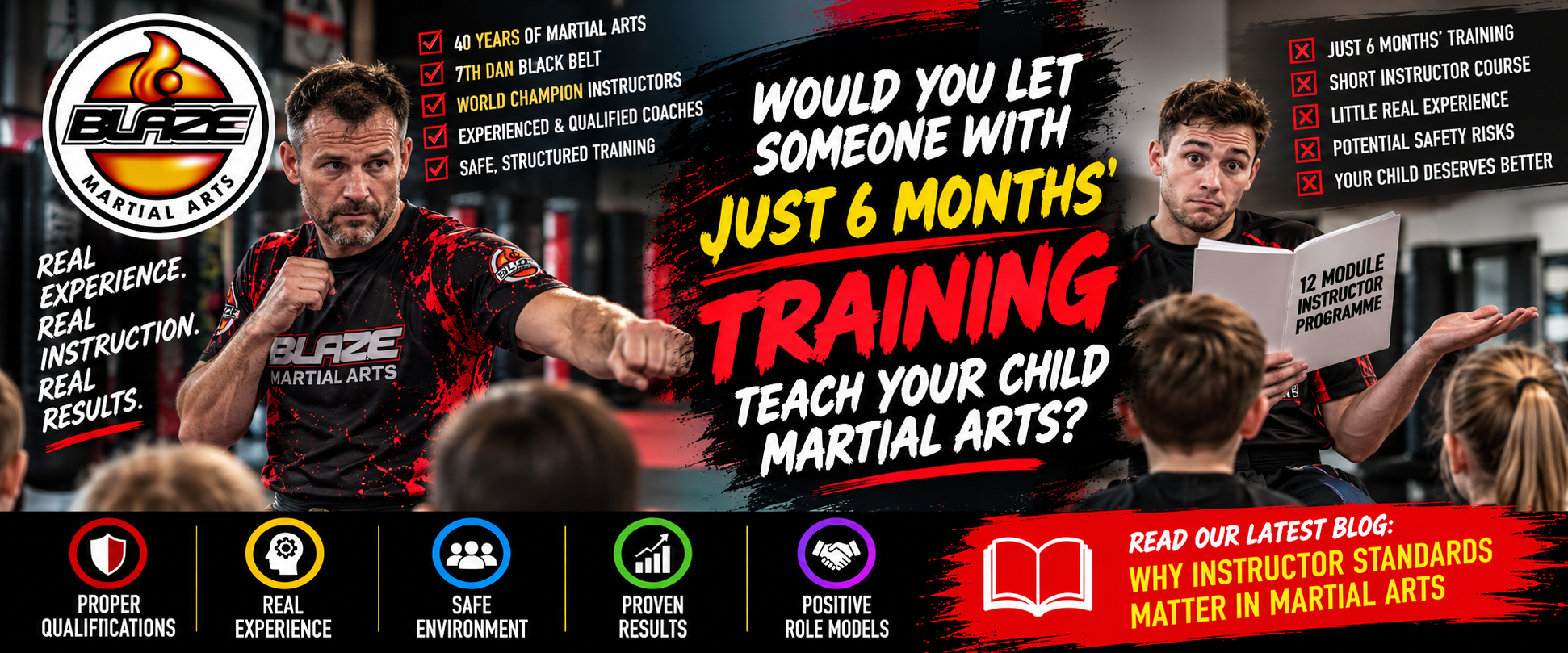
Martial arts instructor qualifications matter because the person teaching you or your child is responsible for far more than running an exercise class. They are teaching complex physical techniques, self-defence concepts, body mechanics and potentially skills somebody may one day rely on under pressure.
I believe that responsibility requires years of genuine martial arts experience.
Recently, I received an e-mail from a Fitness Recruitment Company about an ‘Martial Arts Instructor’ position.
What stopped me in my tracks was one detail.
Applicants apparently needed as little as six months’ training in a striking martial art, followed by a ’12-module instructor-development programme’, before potentially being allowed to then teach children and adults.
I had to read it twice.
I have been involved in martial arts for around 40 years, and I genuinely struggle with the idea that a ’12-module instructor-development programme’ training can give somebody enough understanding to teach another person the intricacies of something that most of us take many years to understand.
This is not about protecting some mythical secret club of black belts.
It is about competence.
It is about safety.
Most importantly, it is about the responsibility we accept when somebody trusts us to teach them martial arts.
What Martial Arts Instructor Qualifications Should You Look For?
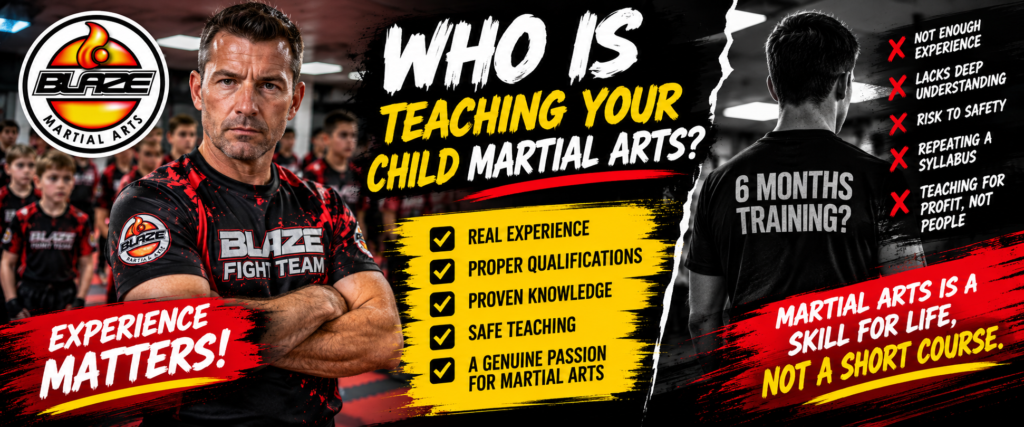
You should look beyond the uniform and ask how long the instructor has actually trained, what grade they hold, who taught them, what actual knowledge and experience they have and whether they are qualified to teach independently.
My own standard is straightforward.
I believe somebody teaching martial arts independently should have reached a minimum of black belt level and accumulated substantial real-world training experience.
THAT is my professional opinion.
At Blaze Martial Arts, our main instructors are experienced black belts.
I am a 7th Dan black belt with around 40 years in martial arts.
Our instructors are Ollie, 4th Dan and a world champion, Cyrus 2nd Dan and fifteen years training, Sam 2nd Dan and similar years training.
Even our coaching team is made up of experienced brown belts and black belts working under senior instructors. Two of which are World Champions.
Experience matters.
Why Isn’t Six Months Enough?
Because martial arts is incredibly detailed.
Take something as basic as a punch.
To a complete beginner, it may appear that you simply move your fist forwards.
An experienced instructor sees far more.
Foot position.
Weight distribution.
Hip rotation.
Shoulder movement.
Guard position.
Distance.
Timing.
Balance.
Breathing.
Recovery.
Target selection.
Power generation.
What happens if the punch misses.
What happens if the opponent moves.
What happens next.
That is one just technique.
Now multiply that by kicks, knees, elbows, combinations, defensive movements, footwork, pad work, sparring, clinching, self-defence, ground work and everything else a martial arts system may contain.
You cannot simply memorise a syllabus and assume you understand the art behind it.
That’s like memorising a flight manual and thinking you can fly a plane.
Knowing what comes next on a lesson plan is not the same as knowing why it works.
Would You Trust a Teacher Who Has Barely Learned the Skill Themselves?
That is the question I think parents should ask.
Imagine somebody learning a complex professional skill for just a few months, completing a short instructor development programme and then immediately teaching other people that skill independently.
Would you be comfortable?
Martial arts sometimes seems to be treated differently because people see children’s classes as just another after-school activity.
I think that is dangerous thinking.
Yes, a children’s class should be fun.
Yes, four-year-olds may spend part of a lesson playing movement games.
But the instructor still needs to understand the martial art.
When a child kicks incorrectly, the instructor should know why as injuries happen if they don’t.
When their knee, ankle or hip is in a poor position, the instructor should recognise it.
When a student cannot generate power, the instructor should understand what needs correcting.
When a self-defence movement is being taught, the instructor should understand its limitations rather than blindly repeating something they learned on a course three weeks earlier.
What Happens When Self-Defence Is Taught Badly?
This is where my concern becomes much more serious.
If somebody teaches an aerobics movement badly, the student may perform the exercise badly.
If somebody teaches self-defence badly, the student may one day rely on that advice when somebody is actually trying to hurt them.
That changes the responsibility completely.
I have spent years studying fighting, competition, self-defence, reality based fighting systems, tradittional martial arts and sport combat arts to the highest level.
Even after four decades, I would never claim that every technique works for every person in every situation. And I know what I am doing.
Experience teaches you nuance.
It teaches you that techniques need context.
It teaches you that size matters.
Distance matters.
Timing matters.
Environment matters.
Stress matters.
The other person’s intent matters.
A short instructor course cannot manufacture that experience.
Coaching Qualifications Matter Too
Being a good martial artist does not automatically make somebody a good coach.
That is another important point.
Technical experience and coaching ability should work together.
UK Coaching says qualifications help coaches develop the appropriate knowledge, skills and behaviours needed to coach effectively. Its safe-practice guidance also says participants have a right to be coached by people who have invested the necessary time in developing their knowledge, skills, safe practices and technical understanding.
You can read its guidance here:
https://www.ukcoaching.org/ukc-club/duty-to-care/safe-to-practice/a-guide-to-safe-to-practice
UK Coaching also makes an important point about scope of competence: if coaching is beyond what somebody is appropriately qualified to deliver, they should not undertake it until they are competent to do so.
That seems like common sense to me.
A coaching certificate is valuable.
A martial arts grade is valuable.
Years of practical training are valuable.
None should be treated as a substitute for all the others.
Parents Should 100% Investigate Who Is Teaching Their Child
Parents routinely investigate schools, childcare and other services involving their children.
Martial arts deserves the same scrutiny.
Before joining a school, I would ask:
How long has the instructor personally trained?
What grade are they?
How long have they been teaching?
Who qualified them?
Have they trained under experienced instructors themselves?
Do they continue to train?
Do they understand the techniques they teach?
Can they perform the techniques they teach?
Are they appropriately insured?
Do they have safeguarding procedures?
Are DBS checks used where required?
Is there a recognised safeguarding structure?
Sport England’s martial-arts safeguarding guidance says providers should have suitable policies, recruitment procedures, safe-practice systems and appropriately qualified coaches.
You can read the guidance here:
https://www.sportengland.org/guidance-and-support/safeguarding/safeguarding-martial-arts
Blaze Martial Arts has also achieved the Safeguarding Code in Martial Arts.
More information about that scheme is available here:
https://www.safeguardingcode.com
The Code was created to help parents make more informed decisions about martial arts providers and examines areas including safeguarding policy, recruitment, safe practice, coach education and training.
Martial Arts Should Not Become Fast Food
I sometimes use the term McDojo mentality.
By that, I mean treating martial arts as a product that can be packaged, simplified, franchised and delivered by almost anybody as long as they follow the script.
That worries me.
A lesson plan can tell you to teach a roundhouse kick.
It cannot give you ten years of experience performing one.
A manual can tell you how a defensive movement is supposed to work.
It cannot give you hundreds of hours spent testing distance, timing and body mechanics.
An instructor module can show somebody how a class is structured.
It cannot replace living the martial art.
You cannot download experience.
Does Every Instructor Need to Be a World Champion?
Absolutely not.
That would be ridiculous.
Competition experience is valuable, but someone does not need a world title to become an excellent instructor.
What I do believe they need is depth.
They need enough years behind them that the basics are genuinely understood rather than recently memorised.
They need to have made mistakes themselves.
They need to have been corrected.
They need to understand what a technique feels like when it is right and recognise when somebody else is performing it badly.
They need to understand the difference between demonstrating a movement and actually teaching it.
Our Blaze instructors happen to include world champions and experienced competitors, but medals are not the point.
Competence is the point.
Martial Arts Is a Responsibility, Not Just a Business Opportunity
Of course martial arts schools need to make money.
We have rent.
Insurance.
Equipment.
Staff.
Advertising.
VAT.
All the normal costs of running a business.
There is nothing wrong with running martial arts professionally.
The problem begins when commercial growth becomes more important than who is trusted to teach.
If a business needs instructors quickly, the answer should not be to lower the level of martial arts experience required until almost anybody can fill the timetable.
In my opinion, that puts the business model before the art.
More importantly, it potentially puts the business model before the student.
That is where I have a serious problem.
Before Joining a Martial Arts School, Ask Questions
Never feel awkward about questioning an instructor’s background.
You are trusting that person with your life or the life of your child.
Ask them.
A good instructor should be perfectly comfortable explaining their experience.
How long have you trained?
What rank are you?
Who taught you?
How long did it take you to reach instructor level?
Do you still train?
Who supervises your teaching?
What safeguarding standards do you follow?
If those questions produce vague answers, I would want to know why.
A black belt alone does not guarantee somebody is a brilliant teacher.
But personally, I would be extremely cautious about putting my child into the hands of someone teaching a complex martial art after only a few months of personal training.
Martial Arts Instructor Qualifications Should Mean Something
For me, martial arts instructor qualifications should represent genuine experience, technical knowledge, teaching ability and responsibility.
Martial arts can build confidence.
It can improve fitness.
It can teach discipline.
It can introduce somebody to competition.
It can provide a lifelong interest.
It can even give somebody useful self-defence skills.
Those benefits are exactly why the standard of the person teaching matters so much.
Every Blaze instructor has spent years learning before being trusted with students.
That is how I believe it should be.
If you are considering martial arts for yourself or your child, investigate the school properly.
Look beyond the adverts.
Look beyond the uniform.
Look beyond the franchise name.
Ask one simple question:
Who is actually teaching me, and how much do they really know?
If you would like to experience the ‘proper’ way we teach at Blaze Martial Arts, you can book a free trial lesson here: https://blazemartialarts.com/free-kickboxing-lesson-2/
We will always be happy to tell you exactly who is teaching your class and the experience they bring to the mats.