
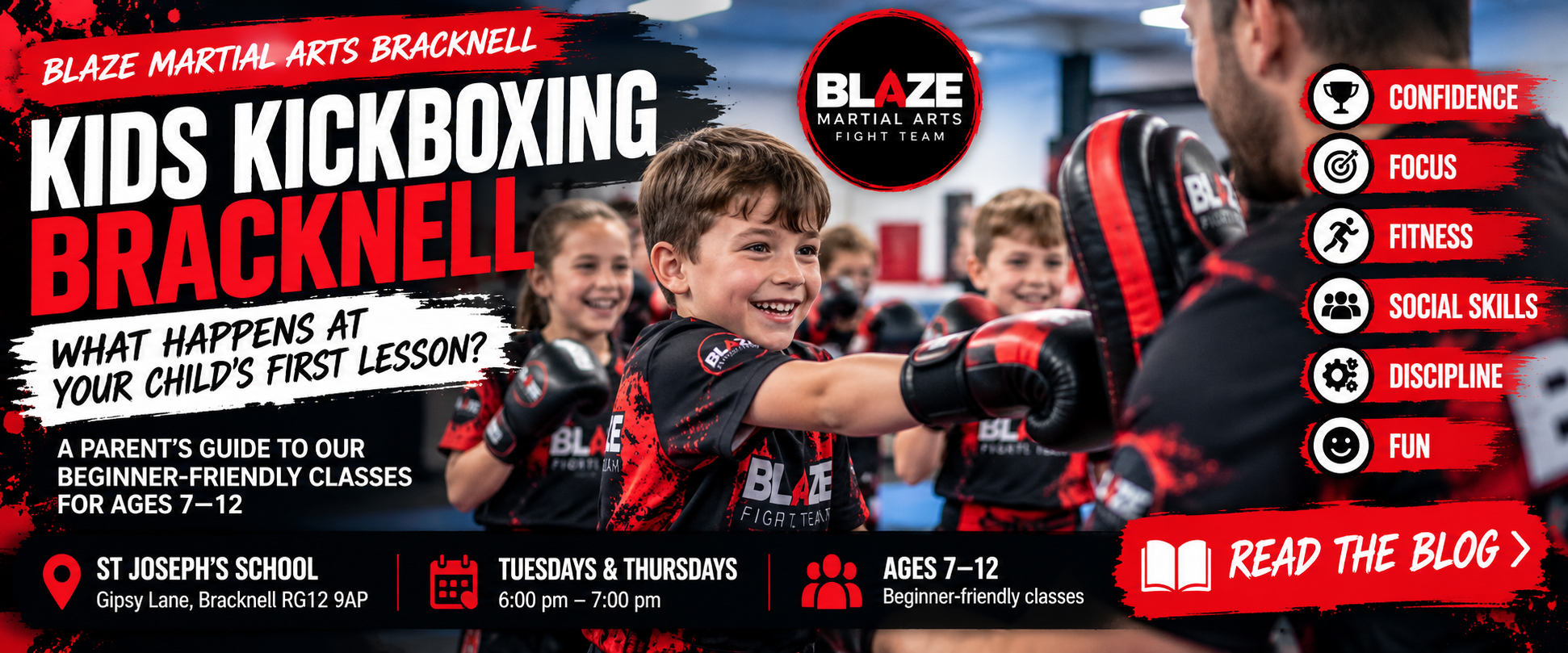
If you’re searching for kids kickboxing Bracknell, you probably have a few questions. Will my child enjoy it? Will they be expected to fight? What if they’re shy, have never done a martial art or find it difficult to concentrate?
They’re sensible questions. A first class should feel welcoming, not overwhelming. At Blaze Martial Arts, we teach children aged 7 to 12 at our Bracknell academy. A free trial lets families see a real class before making any commitment.
Here’s what your child can expect, and why I believe a good martial arts lesson should build much more than a punch or kick.
Kids kickboxing Bracknell: What to Expect on Day One
Walking into a new activity can be a big deal when you’re seven, eight or even twelve. There are unfamiliar faces, new instructions and other children who may already know what they’re doing.
We want beginners to feel included. The instructor explains what the group is working on, how to follow the class and how to train safely around others. Nobody needs to arrive knowing a stance, a technique or a martial arts word.
A typical session starts with a warm-up. That may involve movement, footwork, balance and coordination activities to get everyone ready. The important thing isn’t who can move the fastest. It’s getting children involved, listening and trying their best.
I would much rather see a nervous beginner give one exercise a proper go than feel pressured into pretending they’re confident.
What Will Children Learn at Their First Bracknell Kickboxing Lesson?
Our teaching starts with fundamentals. Children practise how to stand, move, keep their hands in a sensible guard position and perform simple punches and kicks with control.
Then comes one of the parts most children enjoy: focus-pad work. An instructor or suitable training partner holds a padded target while the child practises a technique. We use focus pads, kicking shields and punch bags, with the equipment provided for the trial.
Even a simple drill asks children to look at the target, listen, position their feet, strike with control and recover their balance. They also learn to wait their turn.
That combination of movement, concentration and teamwork is what makes a well-taught class so valuable.
Will my child have to fight or spar?
No. The free trial lesson is non-contact.
We introduce beginners to the techniques and equipment without expecting them to fight another child. Sparring is a separate, controlled part of progression for students who reach the appropriate stage; it is not what we ask a newcomer to do on day one.
This distinction matters. A martial arts class should challenge children, but challenging somebody is not the same as frightening them.
Why kids kickboxing builds confidence outside the gym
Parents often tell us they want their child to grow in confidence. That might mean speaking up more, feeling less intimidated in a new group or being willing to try something that looks difficult.
Confidence arrives in small steps: remembering a combination, volunteering to demonstrate or improving through practice.
Those moments are worth recognising. A child doesn’t have to be the strongest or most naturally athletic in the room to feel proud of their progress.
I also like the structure martial arts brings. Children listen for instructions, follow a sequence, show respect to their training partner and learn that mistakes are part of developing a skill. These are useful habits at school and at home, too.
I wouldn’t promise that one lesson will change a child’s behaviour overnight. Good coaching, encouragement and regular attendance can, however, give children repeated opportunities to practise confidence and self-control.
An after-school activity that gets children moving
After a day sitting at a desk, many children need a proper opportunity to move. Kickboxing uses coordination, balance, body control and bursts of activity in a way that can feel more like a challenge than traditional exercise.
The NHS physical activity guidance for children aged 5 to 18 recommends regular movement, with a daily target of at least 60 minutes of physical activity. It also identifies martial arts as an activity that can contribute to strength and fitness. Wirral Health and Care Trust
A kickboxing class is one enjoyable part of an active week, alongside play, walking, cycling and other sport. For some children, finding an activity they look forward to is the most important first step.
What if my child is shy, easily distracted or worried about joining?
That’s normal. Children aren’t all confident in the same situations, and they don’t have to be.
Before the first class, tell your child they won’t need to know the moves already. Explain that the instructor will show them what to do and that making mistakes is expected.
You could even practise a simple idea together: listen, try, ask if you’re unsure, then try again.
If your child needs a little encouragement, mention that when booking. It helps the team understand how best to welcome them.
Don’t judge their first session by how quickly they learn. Notice whether they join in, have a go and want to return.
How can parents judge whether a martial arts class is safe?
I believe parents should feel comfortable asking questions.
Who is teaching? What experience do they have? How are children supervised? What happens if someone is hurt or worried?
The NSPCC’s advice on martial arts and combat sports encourages parents to ask about club standards and safeguarding rather than assume everything is fine because a class looks professional. NSPCC
At Blaze, we believe children deserve experienced coaches, clear instructions and age-appropriate training.
I’m a 7th Dan black belt and have spent around 40 years in martial arts. Our coaching team includes experienced black belts and World Champions, but the real test is what happens when an instructor helps an ordinary beginner with their first punch.
One story that always reminds me why the first class matters is Cyrus’s progress from a five-year-old beginner to a 2nd Dan instructor.
No parent can know where one trial lesson might eventually lead.
Where are the kids kickboxing classes in Bracknell?
Our Bracknell academy trains at St Joseph’s School, Gipsy Lane, Bracknell, RG12 9AP, on Tuesdays and Thursdays.
Our current combined junior group for ages 7 to 12 trains from 6:00 pm to 7:00 pm.
For younger children aged 4 to 6, we have a separate Little Ninjas class from 5:15 pm to 6:00 pm on the same evenings.
We welcome families from Bracknell, Binfield and the surrounding areas.
Your child can wear comfortable sports clothing and bring a drink of water. Training equipment is supplied for the free trial, so there’s no need to buy a uniform just to find out whether they enjoy it.
Your questions answered
Does my child need any previous experience?
No. Our free trial is designed for complete beginners. They’ll be shown the basics and given a chance to try them.
Is the first lesson suitable for boys and girls?
Absolutely. We welcome boys and girls, and the goal is to help each child improve from their own starting point.
Do they need to be fit before they start?
Not at all. Fitness and coordination develop through regular, age-appropriate training. You don’t need to be good at kickboxing to begin learning it.
Is the free trial really free?
Yes. The trial lets your child experience a normal class without paying for the lesson or committing to membership first.
Try kids kickboxing Bracknell for yourself
The best way to judge a class is to meet the instructors and let your child take part.
If you’re looking for kids kickboxing Bracknell for a seven- to twelve-year-old, we’d love to welcome you.
Book your free Blaze Martial Arts trial lesson or give us a call on 07551 195384.
Bring your child along, let them have a go and see what a properly structured, friendly class feels like.