
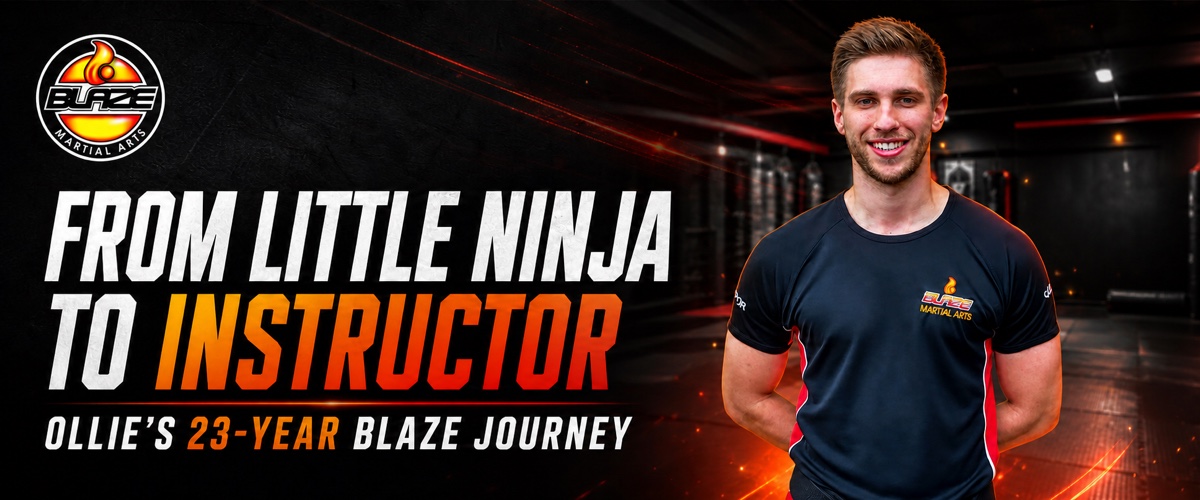
Martial Arts Journey: How martial arts helped one Little Ninja become a black belt, competitor, instructor and role model
Ollie Meakin joined Blaze Martial Arts at just five years old. More than two decades later, he is a black belt, competitor and instructor helping children, teenagers and adults develop confidence, fitness and resilience.
“My earliest memories are from the Little Ninjas class,” Ollie recalls. “Ninja Bubble Wrap was my all-time favourite. I also remember the coach shouting, ‘Lock it up!’ We would clap twice, put our hands on our knees and sit as smartly as we could.”
More than two decades later, Ollie is still at Blaze—but now he is the instructor calling the class to attention.
His story shows what can happen when a child finds an activity they love, receives the right encouragement and keeps turning up. It is also a powerful example of how martial arts and kickboxing can help children, teenagers and adults develop confidence, discipline, resilience and a genuine sense of belonging.
For families and adults looking for martial arts and kickboxing classes in Ascot, Windsor, Bracknell, Wokingham and Sunninghill, Ollie’s journey offers an honest look at what training can become.
How Ollie’s martial arts journey began
Ollie’s interest in martial arts began before he was old enough to join a class.
“My dad was the whole reason I started,” he explains. “He had trained in martial arts since before I was born, so I grew up watching him train in the garage and being desperate to join in.”
From around the age of three, Ollie would sometimes go along to his dad’s karate class. He watched from the side and pretended he was taking part. When he turned five, his dad discovered Blaze Martial Arts—and Ollie has been part of Blaze ever since.
His earliest classes looked a little different from those students attend today.
“We used to wear gis at Blaze,” he laughs. “I remember the ties always coming undone and a coach having to retie them several times during a class.”
The uniform may have changed to shorts and T-shirts, but Ollie says the most important part of Blaze has remained the same: a friendly atmosphere in which people want to see one another succeed.
Can martial arts help a child become more confident?
Confidence is one of the most common reasons parents consider martial arts classes for their children. Ollie has seen first-hand how that confidence can develop over time.
“What makes me most proud is the people,” he says. “Watching children who walked through the doors shy and lacking confidence grow into confident young adults is far more rewarding than any medal I’ve won.”
Children do not need to arrive feeling brave, coordinated or naturally athletic. Blaze’s children’s kickboxing and martial arts classes give young students opportunities to listen, try, make mistakes and recognise gradual improvement in a structured and encouraging environment.
Progress might mean learning a new kick, speaking more confidently to an instructor, completing a difficult exercise or simply joining in when something initially feels unfamiliar.
Those small victories accumulate. Over time, a child begins to understand that being nervous does not mean they cannot succeed.
What can martial arts teach children and teenagers?
For Ollie, martial arts provided much more than physical exercise.
“Martial arts guided me down the right path,” he explains. “It gave me an understanding of respect, dedication and how you get out of life what you put into it.”
These lessons became especially valuable during his teenage years, when many young people begin to lose interest in activities they started as children.
Quitting never seriously crossed Ollie’s mind. Training was something he genuinely enjoyed, rather than a chore he felt forced to complete.
That does not mean every child or teenager will feel motivated before every lesson. Motivation naturally rises and falls. Ollie believes the important thing is not to make a permanent decision because of one difficult week.
His advice to a teenager considering giving up is simple:
“Ask yourself why you started in the first place. Everyone goes through periods when motivation dips, but discipline gets you through those moments. You might be walking away just before your biggest breakthrough.”
Regular martial arts training can give teenagers a positive routine, constructive goals and a healthy way to handle pressure. It also introduces them to coaches and training partners who notice their progress and encourage them to keep moving forward.
Earning his first black belt at ten years old
Ollie remembers receiving his junior first-dan black belt vividly.
Earning his first black belt became a defining moment in Ollie’s martial arts journey.
He was ten years old and had spent six months preparing in the garage with his dad.
“When I discovered I had passed, it was the first real sign that I could achieve whatever I wanted as long as I put the work in.”
His dad had earned his own Blaze black belt the previous year, giving Ollie both inspiration and a goal to pursue.
However, Ollie is keen to challenge one of the biggest misconceptions about black belts: earning one does not mean the work is finished.
“A lot of people think that once grading day is over and the belt is around your waist, you can relax. That couldn’t be further from the truth.”
For Ollie, a black belt represents someone others can look up to. Maintaining that standard requires continued learning, effort and responsibility.
Does a child need to compete in martial arts?
No. Martial arts can be rewarding whether a student wants to compete, work towards belts, improve their fitness or simply enjoy learning new skills.
For those who are interested in competition, however, Ollie believes tournaments provide a unique lesson in resilience.
His first gold medal did not arrive immediately. It took seven competitions before he began bringing gold medals home.
“When people lose repeatedly and success feels completely out of reach, that is often when they quit,” he says. “Persevering through that difficult time is where champions are made.”
Ollie’s own experience is one reason he became passionate about developing a clearer competition pathway through the Blaze fight team. He wants students who aspire to compete—including those with ambitions to reach national-team level—to receive structured support and coaching.
Competition is an option, not an obligation. What matters is helping each student pursue goals that are appropriate for them.
Readers interested in the international competitive side of the sport can learn more about kickboxing disciplines, rules and events through the official World Association of Kickboxing Organizations website.
How martial arts teaches people to manage nerves
Children, teenagers and adults can all feel nervous before a first class, grading, competition or unfamiliar challenge.
Ollie does not believe the answer is to wait for those nerves to disappear.
“You have to use them,” he says. “They never completely go away, but you decide whether they work to your benefit or your detriment.”
Experience helps students recognise nervous energy and channel it productively. Instead of interpreting nerves as proof that they cannot cope, they can learn to see them as a normal response to doing something important.
That lesson can extend far beyond martial arts—to school performances, examinations, job interviews and everyday challenges.
From student to instructor
Ollie began helping in classes when he was around 12 or 13.
“At first, I remember following the other coaches around and feeling like a spare part,” he says. “But even at that level, I felt a sense of responsibility I had never experienced before.”
Teaching eventually became more than something he helped with. It became his career and his biggest passion.
Ollie particularly enjoys working with students who are willing to learn, whatever their starting point or natural ability.
“When you see someone progress or begin to love your passion because of the guidance you have given them, it is the most incredible feeling.”
Becoming an instructor marked an important new stage in his martial arts journey.
Some of his proudest moments have come from watching students and one-to-one clients pass their black-belt gradings after months of preparation.
He had seen their difficult sessions, setbacks and hard work. Watching them tie on a black belt for the first time meant he understood exactly what the achievement represented.
Are kickboxing classes suitable for adult beginners?
Absolutely. Adults do not need previous martial arts experience, exceptional fitness or natural coordination before attending their first class.
Ollie’s message to anyone who feels nervous about getting started is reassuring:
“Everyone starts as a beginner. Nobody expects you to know what you’re doing on day one. The hardest part is walking through the door. Once you’ve done that, you’ll realise everybody else was in exactly the same position once.”
Blaze’s beginner kickboxing classes for teenagers and adults are designed to introduce new students to martial arts gradually and supportively.
Adult martial arts and kickboxing classes can provide:
- Enjoyable full-body exercise
- Improved fitness, balance and coordination
- A productive way to manage stress
- New skills and achievable personal goals
- Greater confidence
- A friendly training community
You also do not need to want to compete. Many adults train for fitness, enjoyment, personal development and the satisfaction of learning something new.
What if a child says they do not want to attend tonight?
Even a child who loves martial arts may occasionally say they would rather stay at home.
Ollie believes this is completely normal.
“Even adults have days when they don’t feel like exercising or going to work,” he says. “Usually, once you have walked through the door and started training, you’re glad you came. Some of your best sessions happen on the days you almost stayed at home.”
Parents can help by remaining calm and focusing on routine rather than turning attendance into an argument. It can also help to distinguish between an occasional lack of enthusiasm and an ongoing concern that needs a proper conversation.
How should parents support a child’s martial arts journey?
Ollie’s advice is to recognise effort and gradual improvement, rather than focusing only on belts, medals or competition results.
“Praise the little things just as much as the big things,” he says. “Turning up, working hard and gradually improving are what matter. Children enjoy martial arts most when they feel supported rather than judged.”
Helpful encouragement might recognise that a child:
- Joined in despite feeling nervous
- Listened carefully
- Tried again after making a mistake
- Showed respect to a partner
- Improved a technique
- Demonstrated patience or perseverance
- Attended consistently
This approach helps children associate martial arts with learning and personal progress rather than fear of disappointing someone.
What helps a student eventually earn a black belt?
“Consistency,” Ollie says. “Talent helps, but consistency beats talent almost every time.”
The students who progress furthest are not necessarily those who find every technique easy. They are the ones who continue to attend, practise, listen and learn—especially on days when they do not feel at their best.
That principle applies equally to a young child in their first martial arts class, a teenager working towards a grading and an adult beginning kickboxing later in life.
More than a martial arts club
Although Blaze has evolved during Ollie’s 23 years with the club, he believes its defining quality has endured.
“The friendly, welcoming atmosphere is what makes Blaze so great,” he says. “It’s like one big family where everyone wants to see each other fulfil their goals.”
That sense of community matters when choosing a martial arts school. Good instruction is essential, but students should also feel welcomed, supported and comfortable learning at their own level.
For Ollie, Blaze was never simply an after-school hobby.
“When you grow up around it, you don’t think about the years passing. Then you stop and realise it has been more than two decades. Blaze has shaped who I am. It has been my life.”
The next chapter in Ollie Meakin’s martial arts journey
Ollie hopes to help Blaze become one of the country’s most respected martial arts clubs while protecting the family atmosphere that makes it special.
His long-term future remains firmly connected to teaching.
“I might not compete forever, but I can’t imagine stepping away from teaching. I will always want to be involved in helping people develop both on and off the mats.”
When asked how he would like to be remembered as an instructor, Ollie does not mention medals or titles.
“I’d like people to remember that I genuinely cared. Winning medals is great, but if students leave Blaze more confident, more respectful and better equipped for life than when they started, I would consider that a success.”
Ollie’s quick-fire round
Favourite martial arts technique: Axe kick
Sparring or pad work: Sparring
Teaching or competing: Teaching
Favourite martial arts film: Ong-Bak
Martial artist he most admires: His dad, Mark Meakin
Toughest people he has sparred: Fellow Team England fighters
A champion he has enjoyed training with: WAKO world champion Fin Heesom
Three things that matter most: Family, peace and a reason to strive for more
One word to describe Blaze: Family
Could you follow in Ollie’s footsteps?
Every instructor, black belt and experienced martial artist began in exactly the same place: their first class.
Whether you are looking for children’s martial arts, kickboxing for teenagers or adult kickboxing classes in Ascot, Windsor, Bracknell, Wokingham or Sunninghill, you do not need any previous experience to get started.
You do not need to be fit before you begin. Your child does not need to be confident already. Nobody is expected to know what to do on day one.
As Ollie says, the hardest part is walking through the door.
If Ollie’s story has inspired you—or your child—to begin your own martial arts journey, book your first free kickboxing trial lesson at Blaze Martial Arts.
Who knows where that first lesson might lead?
Frequently asked questions
What age can children start martial arts?
Blaze offers age-appropriate martial arts training for children, including classes for younger beginners. Visit the Blaze Martial Arts children’s classes page to explore the current programmes and find a suitable class for your child.
Can martial arts help a shy child?
A supportive martial arts class can help shy children develop confidence gradually. They can learn in a structured setting, experience small successes and become more comfortable communicating with instructors and training partners.
Is kickboxing suitable for teenagers?
Yes. Kickboxing can give teenagers exercise, structure, achievable goals and a positive way to handle stress. Training can be recreational or competitive depending on the student’s interests.
Am I too unfit to begin adult kickboxing?
No. Beginners are not expected to arrive with a particular fitness level. Fitness, coordination and technique can develop progressively through regular training.
Do students have to compete?
No. Many people train for confidence, fitness, enjoyment, skills and personal development. Competition can be available for students who want it, but it does not need to be everyone’s goal.
How do I choose a good martial arts class for my child?
Look for qualified, approachable instructors; age-appropriate teaching; clear safety standards; a welcoming atmosphere; and a culture that values effort, respect and gradual progress. A trial class is a useful way to see how your child responds to the environment.
Where does Blaze Martial Arts run classes?
Blaze provides martial arts and kickboxing classes in Windsor, Bracknell, Ascot and Wokingham, including an Ascot academy in Sunninghill. Visit the Blaze Martial Arts academies and class information page to find the most convenient option.
How can I try a class?
Ollie Meakin’s martial arts journey began with one childhood class, and your journey—or your child’s—could begin in exactly the same way.
New students can book a free trial kickboxing lesson before deciding whether to join. Complete beginners are welcome.